
As a leader, how much coaching and how much directing do you do?
And why is this distinction important?
It’s important because most leaders are expected to coach their teams but they:
(1) Don’t quite know the difference between coaching and traditional directing, or
(2) If they know the difference, they don’t know under what circumstances to use either approach.
So, let’s start by explaining the difference.
In the simplest of terms, Coaching is focused on using questions to help the person tap into their own capability, to discover solutions to challenges.
Directing is focused on instructing the person as to what they need to do to solve a challenge.
Next, when do we coach and when do we direct?
A useful way to determine which leadership style to use is based on Max Landberg’s “Skill-Will Matrix”. Leaders can use this matrix to plot where their team members fall on the matrix, then use the most appropriate style for each combination of person and situation. Will refers to motivation or enthusiasm for the task, challenge or overall demeanour and drive at work. Skill refers to competence or ability to carry out the task or challenge. It can include experience level.
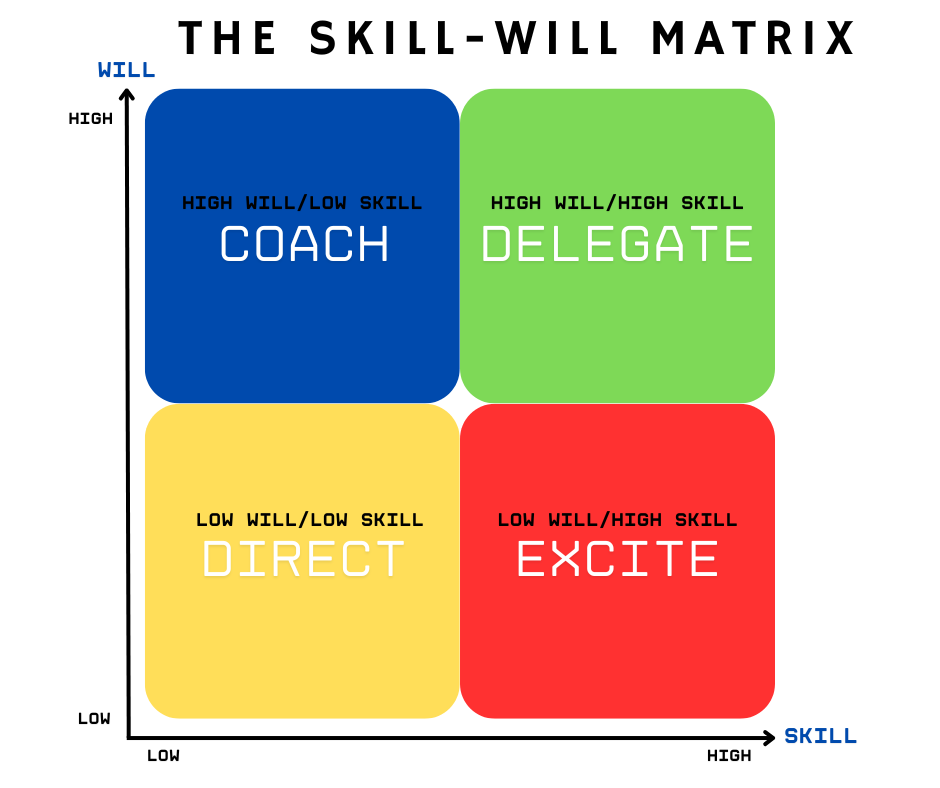
Based on the matrix, in a given situation, a leader should:
(1) Coach, if a team member has high will but low skill. The leader should guide, stretch and train them to develop their skills and explore their potential.
(2) Direct, if a team member has low will and low skill. The leader should set clear expectations and instructions and provided structured tasks and monitor closely.
(3) Delegate, if a team member has high will and high skill. The leader should empower them, provide mentorship and allow them autonomy.
4) Excite, if a team member has low will and high skill. The leader should match tasks to their interests and increase their engagement by recognising their achievements.
You can use this easy framework on a day-to-day basis to improve your team leadership.